Circle quilt block
Four quarter-circle units rotated so the arcs close into a full circle inside a square. It is the gateway to curved piecing.
Also known as Full Circle, Four Quarter-Circles.
Curved piecing is old — Drunkard's Path and Orange Peel both predate the Civil War — but a full circle assembled from four quarters is the clearest way to learn the technique, because any error in the seam shows immediately as a kink in the arc.
Circle cutting chart
Cut sizes include a ¼″ seam allowance: ½″ on squares and rectangles, ⅞″ on half-square triangles, and 1¼″ on quarter-square triangles. Pick a finished block size:
| Fabric | Shape | Cut size | Qty | Notes |
|---|---|---|---|---|
| Background | Background template | 4" × 4" | 4 | 3" finished radius |
| Dark | Pie template | 4" × 4" | 4 | 3" finished radius |
| Fabric | Shape | Cut size | Qty | Notes |
|---|---|---|---|---|
| Background | Background template | 5½" × 5½" | 4 | 4½" finished radius |
| Dark | Pie template | 5½" × 5½" | 4 | 4½" finished radius |
| Fabric | Shape | Cut size | Qty | Notes |
|---|---|---|---|---|
| Background | Background template | 6" × 6" | 4 | 5" finished radius |
| Dark | Pie template | 6" × 6" | 4 | 5" finished radius |
| Fabric | Shape | Cut size | Qty | Notes |
|---|---|---|---|---|
| Background | Background template | 7" × 7" | 4 | 6" finished radius |
| Dark | Pie template | 7" × 7" | 4 | 6" finished radius |
| Fabric | Shape | Cut size | Qty | Notes |
|---|---|---|---|---|
| Background | Background template | 8½" × 8½" | 4 | 7½" finished radius |
| Dark | Pie template | 8½" × 8½" | 4 | 7½" finished radius |
How it goes together
Four quarter-circle units, each a convex pie and a concave background, rotated to meet. The concave and convex edges are both cut on a curve; they are pinned at the centre and ends first, then eased together.
Tips
- Pin the centre of the arc first, then both ends, then ease the rest — never stretch one edge to fit the other.
- Sew with the concave piece on top so you can see and control the ease as it feeds.
- A shorter stitch length through the curve gives you more control and less puckering.
How much fabric for a Circle quilt?
Yardage for a whole quilt of Circle blocks, computed the way the studio does it — every piece packed across a 40″ usable width with 10% added for waste.
| Quilt size | Blocks | Finished | Top fabric | Backing | Binding |
|---|---|---|---|---|---|
| Baby 36×48 | 12 | 36" × 48" | Background 2¼ yd · Dark 2¼ yd | 2½ yd | ⅜ yd |
| Throw 60×72 | 30 | 60" × 72" | Background 5¼ yd · Dark 5¼ yd | 3⅞ yd | ½ yd |
| Queen 90×108 | 72 | 96" × 108" | Background 12½ yd · Dark 12½ yd | 8¾ yd | ⅞ yd |
What it looks like in a quilt
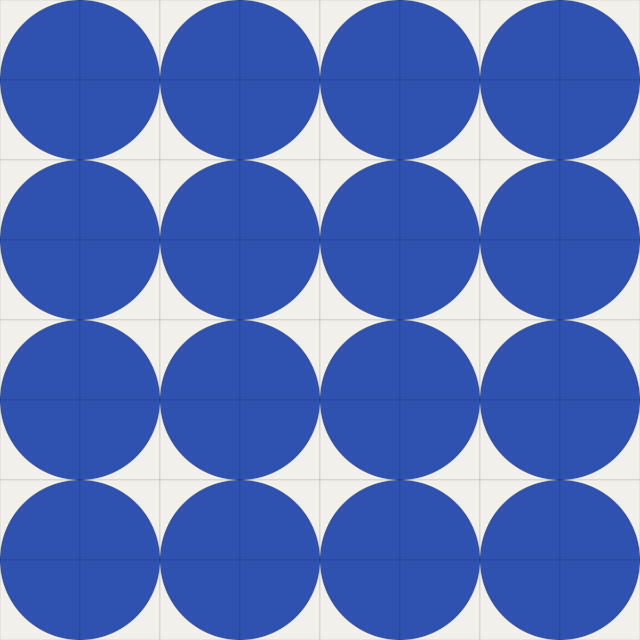
A single block only tells you half the story. Set sixteen of them together and the secondary pattern appears where the blocks touch:
Circle questions
Is curved piecing hard?
It is different rather than hard. The seam is sewn with pins at the centre and ends and the fabric eased between them; once the motion is familiar it goes as fast as a straight seam.
Do I need special templates?
For traditional cutting yes, or an acrylic template set. FourPatch gives you the finished geometry and the cut sizes so you can make or buy the right template.