Flying Geese quilt block
The flying-geese unit repeated across a whole block — a rectangle twice as wide as it is tall, with a triangle point and two background corners.
Also known as Geese, Wild Goose Chase unit.
Flying geese are less a block than the single most useful unit in pieced quilting. They form the points of Sawtooth Stars, the whole of Dutchman's Puzzle, the borders of medallion quilts and the columns of Wild Goose Chase. Every quilter eventually learns to make them four at a time.
Flying Geese cutting chart
Cut sizes include a ¼″ seam allowance: ½″ on squares and rectangles, ⅞″ on half-square triangles, and 1¼″ on quarter-square triangles. Pick a finished block size:
| Fabric | Shape | Cut size | Qty | Notes |
|---|---|---|---|---|
| Background | HST square | 2⅜" × 2⅜" | 8 | cut once on the diagonal → 16 triangles |
| Dark | HST square | 2⅜" × 2⅜" | 8 | cut once on the diagonal → 16 triangles |
| Fabric | Shape | Cut size | Qty | Notes |
|---|---|---|---|---|
| Background | HST square | 3⅛" × 3⅛" | 8 | cut once on the diagonal → 16 triangles |
| Dark | HST square | 3⅛" × 3⅛" | 8 | cut once on the diagonal → 16 triangles |
| Fabric | Shape | Cut size | Qty | Notes |
|---|---|---|---|---|
| Background | HST square | 3⅜" × 3⅜" | 8 | cut once on the diagonal → 16 triangles |
| Dark | HST square | 3⅜" × 3⅜" | 8 | cut once on the diagonal → 16 triangles |
| Fabric | Shape | Cut size | Qty | Notes |
|---|---|---|---|---|
| Background | HST square | 3⅞" × 3⅞" | 8 | cut once on the diagonal → 16 triangles |
| Dark | HST square | 3⅞" × 3⅞" | 8 | cut once on the diagonal → 16 triangles |
| Fabric | Shape | Cut size | Qty | Notes |
|---|---|---|---|---|
| Background | HST square | 4⅝" × 4⅝" | 8 | cut once on the diagonal → 16 triangles |
| Dark | HST square | 4⅝" × 4⅝" | 8 | cut once on the diagonal → 16 triangles |
How it goes together
The no-waste method: one large square and four small ones produce four geese with every outer edge on the straight grain and nothing left over. The alternative — a rectangle plus two corner squares — is simpler but wastes fabric and puts bias where you would rather not have it.
Tips
- Four-at-a-time: cut the large square 1¼ inches bigger than the finished width, and the four small squares ⅞ inch bigger than the finished height.
- Trim each goose to size before assembly. Untrimmed geese are the main reason star points vanish.
- The tip of the triangle sits a quarter inch below the raw edge on the finished unit. If it touches the edge, it is already too small.
How much fabric for a Flying Geese quilt?
Yardage for a whole quilt of Flying Geese blocks, computed the way the studio does it — every piece packed across a 40″ usable width with 10% added for waste.
| Quilt size | Blocks | Finished | Top fabric | Backing | Binding |
|---|---|---|---|---|---|
| Baby 36×48 | 12 | 36" × 48" | Background 1¼ yd · Dark 1¼ yd | 2½ yd | ⅜ yd |
| Throw 60×72 | 30 | 60" × 72" | Background 2⅞ yd · Dark 2⅞ yd | 3⅞ yd | ½ yd |
| Queen 90×108 | 72 | 96" × 108" | Background 6⅞ yd · Dark 6⅞ yd | 8¾ yd | ⅞ yd |
What it looks like in a quilt
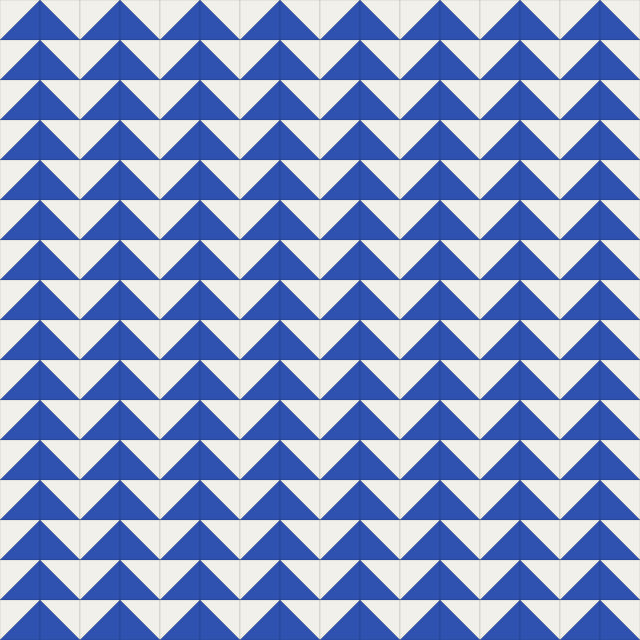
A single block only tells you half the story. Set sixteen of them together and the secondary pattern appears where the blocks touch:
Flying Geese questions
What size squares for 3 by 6 inch finished flying geese?
One 7¼ inch square and four 3⅞ inch squares make four geese, with no waste and no bias on the outer edges.
Why do my flying geese finish too small?
Usually a seam allowance slightly over a quarter inch, compounded across the two diagonal seams. Cutting oversized and trimming to exact size solves it permanently.