Kaleidoscope quilt block
Eight wedges radiating from the centre into a regular octagon, with four small triangles filling the corners of the square. Alternate the wedges light and dark and the block spins.
Also known as Kaleidoscope block, Octagon block, Spider Web.
The Kaleidoscope block is a product of the late nineteenth century, when the toy of the same name was still a novelty and quilters were fond of anything that suggested optical trickery. It is closely related to Spider Web, and quilters have used both names for the same drafting for well over a century. Its enduring appeal is that four blocks set together make a second, larger star that belongs to none of them.
Kaleidoscope cutting chart
Cut sizes include a ¼″ seam allowance: ½″ on squares and rectangles, ⅞″ on half-square triangles, and 1¼″ on quarter-square triangles. Pick a finished block size:
| Fabric | Shape | Cut size | Qty | Notes |
|---|---|---|---|---|
| Accent | HST square | 2⅝" × 2⅝" | 2 | cut once on the diagonal → 4 triangles |
| Background | Kaleidoscope wedges | template 3¼" × 3⅞" | 4 | cut with the full-size template the pattern prints |
| Dark | Kaleidoscope wedges | template 3¼" × 3⅞" | 4 | cut with the full-size template the pattern prints |
| Fabric | Shape | Cut size | Qty | Notes |
|---|---|---|---|---|
| Accent | HST square | 3½" × 3½" | 2 | cut once on the diagonal → 4 triangles |
| Background | Kaleidoscope wedges | template 4½" × 5⅜" | 4 | cut with the full-size template the pattern prints |
| Dark | Kaleidoscope wedges | template 4½" × 5⅜" | 4 | cut with the full-size template the pattern prints |
| Fabric | Shape | Cut size | Qty | Notes |
|---|---|---|---|---|
| Accent | HST square | 3¾" × 3¾" | 2 | cut once on the diagonal → 4 triangles |
| Background | Kaleidoscope wedges | template 4⅞" × 5⅞" | 4 | cut with the full-size template the pattern prints |
| Dark | Kaleidoscope wedges | template 4⅞" × 5⅞" | 4 | cut with the full-size template the pattern prints |
| Fabric | Shape | Cut size | Qty | Notes |
|---|---|---|---|---|
| Accent | HST square | 4⅜" × 4⅜" | 2 | cut once on the diagonal → 4 triangles |
| Background | Kaleidoscope wedges | template 5¾" × 6⅞" | 4 | cut with the full-size template the pattern prints |
| Dark | Kaleidoscope wedges | template 5¾" × 6⅞" | 4 | cut with the full-size template the pattern prints |
| Fabric | Shape | Cut size | Qty | Notes |
|---|---|---|---|---|
| Accent | HST square | 5¼" × 5¼" | 2 | cut once on the diagonal → 4 triangles |
| Background | Kaleidoscope wedges | template 7" × 8⅜" | 4 | cut with the full-size template the pattern prints |
| Dark | Kaleidoscope wedges | template 7" × 8⅜" | 4 | cut with the full-size template the pattern prints |
How it goes together
Piece the eight wedges into two half-octagons, join those into a full octagon, then add the four corner triangles. The centre is where eight seams meet, so accuracy at the wedge tips is what makes or breaks it.
Tips
- Trim the tip off each wedge before you sew. A blunted point is easier to align and removes the bulk that otherwise builds into a lump at the centre.
- Press the octagon’s seams all one way around, like a fan. Pressing them open is tempting but leaves the centre weak where eight seams cross.
- Value, not colour, makes it spin. Alternate light and dark round the octagon and the block turns; use eight colours of the same value and it just sits there.
How much fabric for a Kaleidoscope quilt?
Yardage for a whole quilt of Kaleidoscope blocks, computed the way the studio does it — every piece packed across a 40″ usable width with 10% added for waste.
| Quilt size | Blocks | Finished | Top fabric | Backing | Binding |
|---|---|---|---|---|---|
| Baby 36×48 | 12 | 36" × 48" | Background 1¾ yd · Dark 1¾ yd · Accent ½ yd | 2½ yd | ⅜ yd |
| Throw 60×72 | 30 | 60" × 72" | Background 4¼ yd · Dark 4¼ yd · Accent 1 yd | 3⅞ yd | ½ yd |
| Queen 90×108 | 72 | 96" × 108" | Background 10¼ yd · Dark 10¼ yd · Accent 2¼ yd | 8¾ yd | ⅞ yd |
What it looks like in a quilt
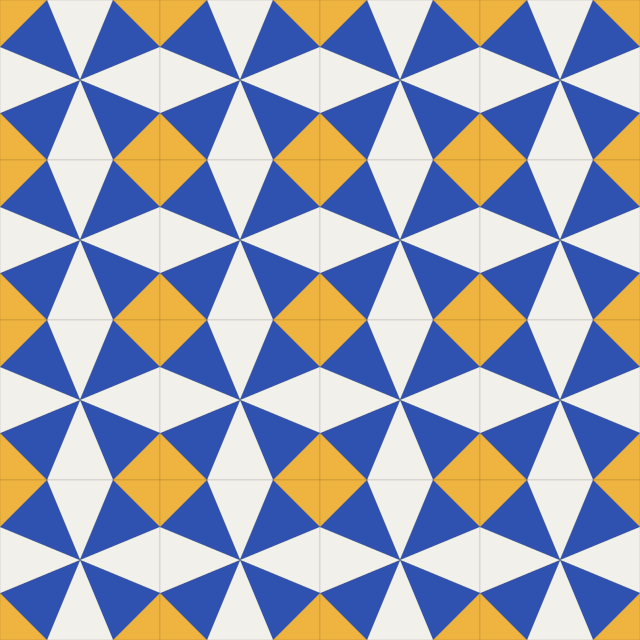
A single block only tells you half the story. Set sixteen of them together and the secondary pattern appears where the blocks touch:
Kaleidoscope questions
Why does the octagon have to be regular?
So all eight wedges are the same piece. Trimming exactly 0.2929 of the side off each corner — that is 1 ÷ (2 + √2) — is the only cut that makes the eight octagon edges equal, which is why FourPatch draws it that way and prints one wedge template rather than two.
What is the difference between Kaleidoscope and Spider Web?
In practice, very little. Spider Web usually implies the wedges are themselves strip-pieced from scraps; Kaleidoscope usually implies solid wedges. The drafting is the same.
Can I piece this without templates?
Not really — the wedge is not a rotary-cut shape. FourPatch prints a full-size template for it with the cutting line and the finished line both marked.