Spinning Star quilt block
A kaleidoscope block coloured so the wedges read as a star with the corners in the accent, giving a clear sense of rotation.
Also known as Kaleidoscope star, Pinwheel star.
Every eight-wedge block is one recolouring away from a star, and quilters have found that recolouring independently in every generation. What distinguishes this one is that the corner triangles carry the accent rather than the background, which pushes the octagon forward and makes the star appear to float and turn.
Spinning Star cutting chart
Cut sizes include a ¼″ seam allowance: ½″ on squares and rectangles, ⅞″ on half-square triangles, and 1¼″ on quarter-square triangles. Pick a finished block size:
| Fabric | Shape | Cut size | Qty | Notes |
|---|---|---|---|---|
| Accent | Kaleidoscope wedges | template 3¼" × 3⅞" | 4 | cut with the full-size template the pattern prints |
| Background | Kaleidoscope wedges | template 3¼" × 3⅞" | 4 | cut with the full-size template the pattern prints |
| Dark | HST square | 2⅝" × 2⅝" | 2 | cut once on the diagonal → 4 triangles |
| Fabric | Shape | Cut size | Qty | Notes |
|---|---|---|---|---|
| Accent | Kaleidoscope wedges | template 4½" × 5⅜" | 4 | cut with the full-size template the pattern prints |
| Background | Kaleidoscope wedges | template 4½" × 5⅜" | 4 | cut with the full-size template the pattern prints |
| Dark | HST square | 3½" × 3½" | 2 | cut once on the diagonal → 4 triangles |
| Fabric | Shape | Cut size | Qty | Notes |
|---|---|---|---|---|
| Accent | Kaleidoscope wedges | template 4⅞" × 5⅞" | 4 | cut with the full-size template the pattern prints |
| Background | Kaleidoscope wedges | template 4⅞" × 5⅞" | 4 | cut with the full-size template the pattern prints |
| Dark | HST square | 3¾" × 3¾" | 2 | cut once on the diagonal → 4 triangles |
| Fabric | Shape | Cut size | Qty | Notes |
|---|---|---|---|---|
| Accent | Kaleidoscope wedges | template 5¾" × 6⅞" | 4 | cut with the full-size template the pattern prints |
| Background | Kaleidoscope wedges | template 5¾" × 6⅞" | 4 | cut with the full-size template the pattern prints |
| Dark | HST square | 4⅜" × 4⅜" | 2 | cut once on the diagonal → 4 triangles |
| Fabric | Shape | Cut size | Qty | Notes |
|---|---|---|---|---|
| Accent | Kaleidoscope wedges | template 7" × 8⅜" | 4 | cut with the full-size template the pattern prints |
| Background | Kaleidoscope wedges | template 7" × 8⅜" | 4 | cut with the full-size template the pattern prints |
| Dark | HST square | 5¼" × 5¼" | 2 | cut once on the diagonal → 4 triangles |
How it goes together
Identical piecing to the Kaleidoscope block — eight wedges and four corners — with the colours assigned differently.
Tips
- The direction of the spin is set by which of each pair of wedges is dark. Change it in the block editor and watch the block reverse.
- Because the corner triangles are the accent, the block wants a quiet background around it — a plain alternate block or generous sashing.
- Try it on point. The star already suggests rotation and a 45° set exaggerates it.
How much fabric for a Spinning Star quilt?
Yardage for a whole quilt of Spinning Star blocks, computed the way the studio does it — every piece packed across a 40″ usable width with 10% added for waste.
| Quilt size | Blocks | Finished | Top fabric | Backing | Binding |
|---|---|---|---|---|---|
| Baby 36×48 | 12 | 36" × 48" | Background 1¾ yd · Dark ½ yd · Accent 1¾ yd | 2½ yd | ⅜ yd |
| Throw 60×72 | 30 | 60" × 72" | Background 4¼ yd · Dark 1 yd · Accent 4¼ yd | 3⅞ yd | ½ yd |
| Queen 90×108 | 72 | 96" × 108" | Background 10¼ yd · Dark 2¼ yd · Accent 10¼ yd | 8¾ yd | ⅞ yd |
What it looks like in a quilt
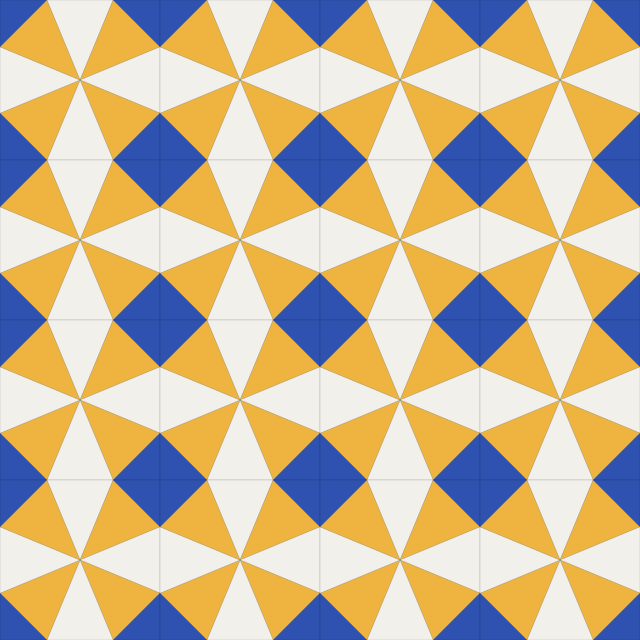
A single block only tells you half the story. Set sixteen of them together and the secondary pattern appears where the blocks touch:
Spinning Star questions
Is this a traditional block name?
It is a descriptive one. The drafting is the traditional Kaleidoscope; the name here refers to the colourway, which is how most eight-wedge variants get their names.
Why do my wedges not meet in the middle?
Usually the seam allowance at the tip. Eight seams converge on one point, so an error of a sixteenth on each becomes half an inch of overlap. Trim the tips before sewing and press around the octagon like a fan.